

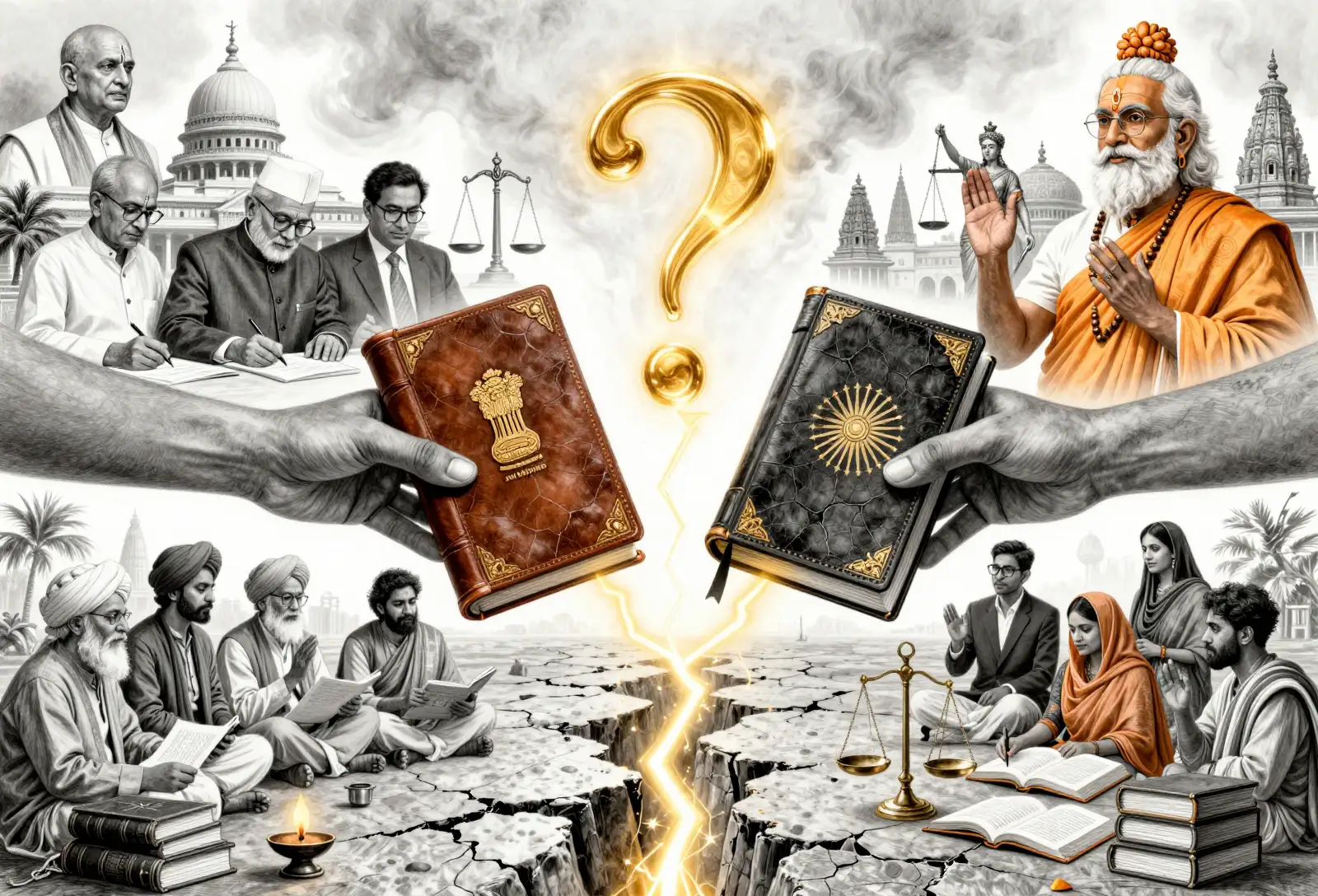
Does India Need Another Republic
Does India's constitution - built on rights rather than duties, and arguably biased against Hindus - need to be replaced with a second republic rooted in Dhārmika values?
#hindu institutions
Indian constitution is one of the lengthiest in the world, and yet it has had several amendments indicating that the constitution writers left many loopholes while creating it. Many interest groups in India object to the constitution in varied ways, and some claim that it harbors hidden biases against Hindu society. Some claim that it is also most favorably biased in favor of particularly Islamic and Christian minorities, hence perpetually and institutionally disadvantaging the Hindu majority. They claim for another constitution which is equal to all and has no discrimination for any society.
Other Hindu scholars see the problem from a different dimension, and claim that the very spirit of the constitution is not Hindu as it is based upon a narrative of rights - and the Hindu universe is based upon the narrative of duties. None other than PV Kane, the scholar of Dharmashastras, objected to the constitution in this way. This leads to the demand that India needs another constitution and another republic. While so-called secular parties reject this demand stating it as a Hindu fascist push, opponents claim that when France could have five republics then why should India not have the second republic? This big question deals with this extremely difficult question and produces answers from many different corners of Hindu society.
Also See
blog
Towards Dharma-centric Polity - Lokmanya Tilak and the Universalization of Gaṇeśa Utsava
As dharma recedes from both personal life and public governance, what would a genuinely dharma-centric political order look like - and is it achievable within or only beyond the current Indian constitutional framework?
external-article
Does India Have a National Language?
The national language question as a civilizational problem, not a policy one — why Nehru's Hindi gambit failed, what the absence of a unifying language costs India, and what Sanskrit's role should be.
external-article
Unfinished Agendas of Radical Islam - The Global Gameplan
Opening the Unfinished Agendas series: the ideological architecture of radical Islam's global strategy — how the anti-CAA riots are not a spontaneous reaction but a calculated move in a long-running civilizational campaign.
external-article
We the Hindus - What the CAB Means for Hindu Civilization
The Citizenship Amendment Act read as a civilizational turning point — not refugee policy but India's first post-colonial assertion of its Hindu identity, and what the civilizational stakes of this assertion actually are.
book
Arthashastra
Classical treatise on statecraft, administration, diplomacy, economy, espionage, and royal governance.
book
Panchayat Raj and India's Polity
Study of village governance and decentralized political structures in Indian constitutional and civilizational context.