

What Idea Must Die, for Hindu Renaissance
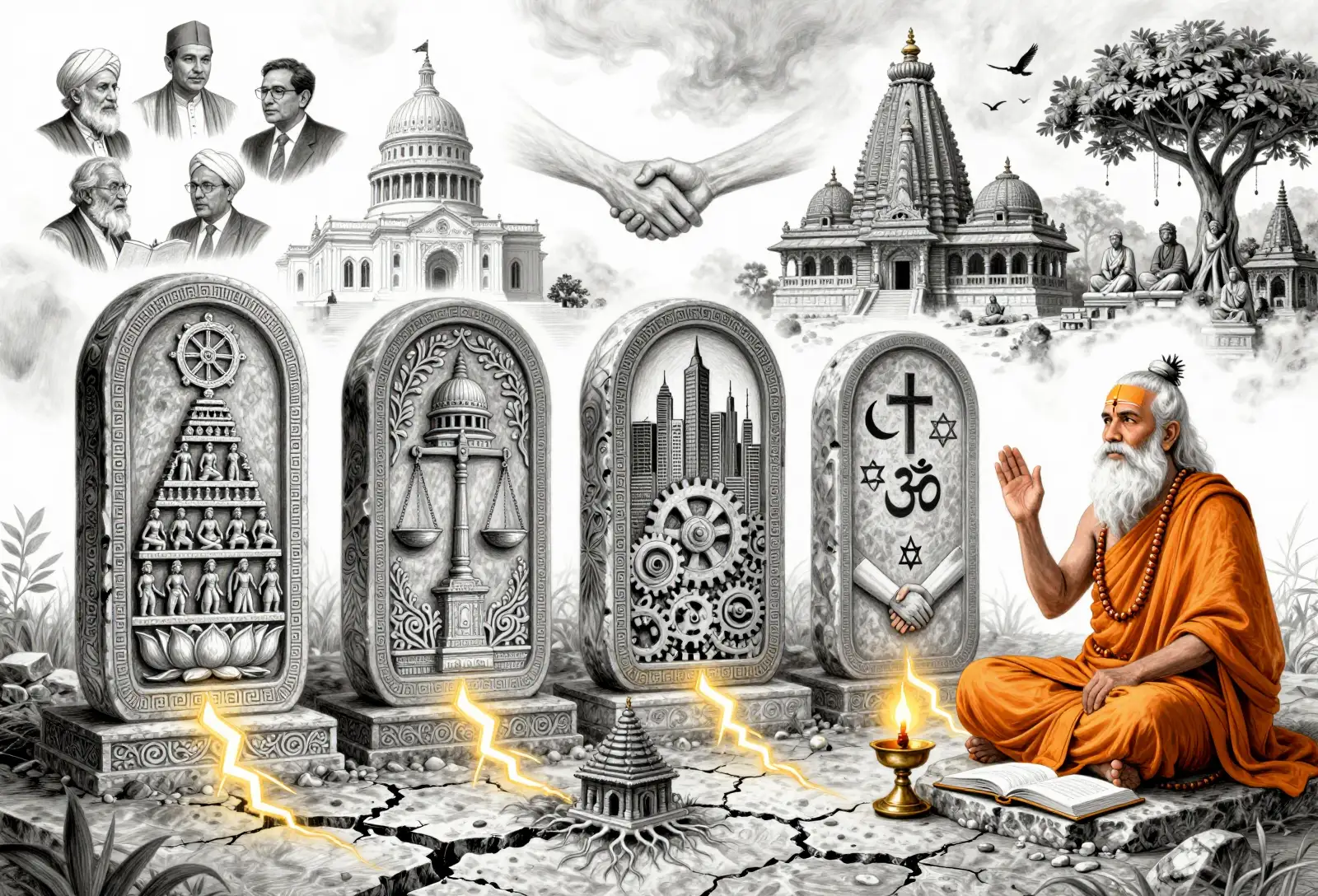
What idea must die for Hindu renaissance to happen - caste, secularism, modernity, sarva-dharma-samabhāva, or the very category of religion applied to dharma?
#civilizational consciousness
#hindu renaissance
The proponents of Hindu renaissance have a blueprint. Or rather many blueprints, for different groups have different ideas of what is Hindu renaissance and how to achieve it. And each of them believes that there are certain roadblocks in Hindu renaissance. This roadblock is generally understood to be an idea which keeps the colonial and slave mentality in place, and prevents Hindu renaissance from happening. Is it the idea of caste which prevents Hindus from uniting, as some groups say? Or is it the idea of secularism which has imposed a false faultline on Indian society, where the conditions to implement secularism never existed? Some neo-traditional Hindus believe it is the very idea of modernity which must die for Hindu renaissance to happen, since it is modernity which killed varnashrama dharma and with it the Hindu society too.
Many also powerfully believe that it is the false idea of sarva-dharma-samabhava that must die for Hindu renaissance to happen. They claim that all religions are not the same, and hence this false equivalence leads to disastrous consequences for Hindus. Some even say that the false equivalence is at the level of categories, and that dharma is not religion and vice-versa, as it is untranslatable. This big question asks this provocative question to list the ideas that must die for Hindu renaissance to happen.
Also See
blog
Book Review | Svayambodha and Shatrubodha
A review of Pankaj Saxena's 'Svayambodha and Shatrubodha' - the book that gives Hindu civilizational discourse its most precise vocabulary for self-knowledge and knowledge of adversarial forces.
blog
Decolonizing Language
How colonialism froze the evolution of North Indian vernaculars by installing FATE languages (Farsi, Arabic, Turkish, English) as prestige languages - and what it would take to let them grow again.
blog
Svayambodha and Śatrubodha - Two Wheels of Civilization
Hindu civilizational discourse has entered its sophisticated phase - an argument that Svayambodha (self-knowledge) and Shatrubodha (knowledge of the adversary) now constitute a canonical framework.
blog
Decolonization - A Personal Footprint and Some Ramp Ways
Decolonization as daily practice - a personal account of what it actually looks like to replace a colonial operating system of the mind - starting with the words you use, the foods you eat, the festivals you observe.
external-article
Witzel's Realm - On Reputationist Concerns Over India's Reclamation of Its History
A direct response to Michael Witzel's attack on Indian historical revisionism — defending the legitimacy of indigenous Purāṇic chronology against Western academic gatekeeping dressed up as methodological rigor.
book
German Indology Aryanism and Anti Semitism
Study of German Indology and its entanglement with racial theory, Aryanism, and anti-Semitism.
book
Pride and Prejudice Orientalism and Germany
Study of German orientalism and the ideological lenses shaping Indological interpretation.
book
The Banality of Indology
Sharp critique of routinized assumptions and methodological shallowness in Indological scholarship.
book
The Origins of Racism in the Humanities
Argument about how racial categories entered humanistic scholarship through philology and related disciplines.
book
Theses on Indology
Programmatic theses outlining a critique of Indology and an alternative scholarly orientation.
book
Essays on Tradition, Recovery and Freedom
Essays on cultural continuity, intellectual decolonization, and the recovery of civilizational freedom.
book
Pūrva-pakṣa of Sheldon Pollock's use of Chronology
A critical examination of Sheldon Pollock's chronological methodologies, offering counterarguments rooted in traditional Indian historiography and textual analysis.
book
On Talageri
Critical review of Shrikant Talageri's Out of India theories, contrasting traditional Vedic chronology with mainstream Indo-European migration models.
book
The Harappan Heritage And The Aryan Problem
Examines cultural and archaeological continuity between the Indus Valley Civilization and early Vedic culture, addressing the Aryan migration narrative.