

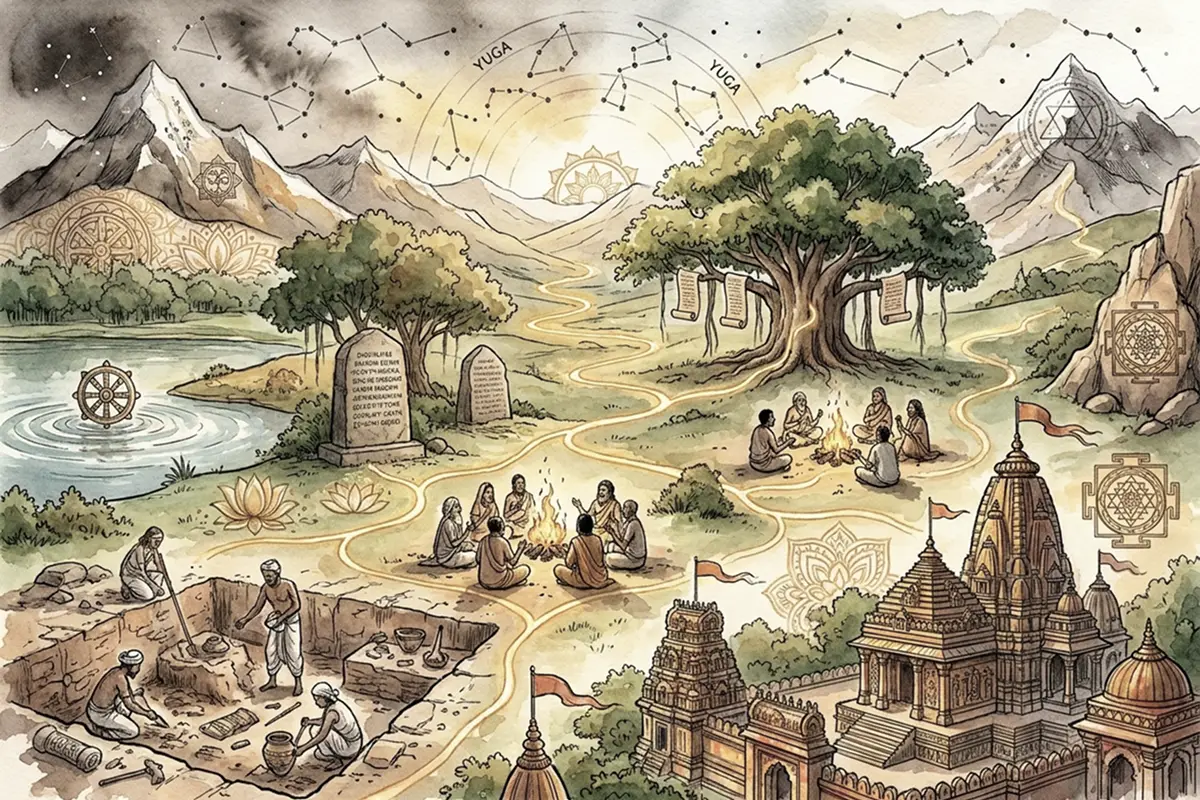
Hindu School of History

A project to develop a historiographical approach that interprets the past through a dharmic lens for civilizations, continuity, time, and epistemological frameworks.

The study of history is never a neutral accumulation of facts alone. Every major historiographical tradition approaches the past through certain assumptions about time, causation, human agency, evidence, society, and meaning. Marxist historiography foregrounds class relations and material conditions, the Annales School emphasizes long-duration social and civilizational patterns, positivist historiography prioritizes archival verification and empirical objectivity, postmodern approaches examine discourse, power, and the instability of historical truth, and Subaltern Studies recovers the agency of those excluded from elite narratives. Each of these schools has contributed important tools to historical understanding, but each also carries its own philosophical premises and limitations.

In the Indian context, the need for a serious re-examination of historiographical method is especially urgent. Much of Indian history has been written through frameworks inherited from colonial scholarship, European periodization, Marxist materialism, nationalist reaction, or postcolonial critique. These approaches have often fragmented India’s civilizational continuity, marginalized indigenous categories of thought, and treated living traditions as secondary to external theoretical models.

With inspiration from thinkers such as Shri KM Munshi and Shri Ram Swarup, this research examines whether a distinct “Hindu School of History” can be developed as a rigorous, self-aware, and academically responsible historiographical framework. Such a school would ask whether concepts such as dharma, itihasa, purana, yuga, karma, samskara, civilizational continuity, pilgrimage networks, temple geography, oral memory, and textual tradition can serve as legitimate categories for historical interpretation.

Also See

blog

Grand History, Part 1

A speculative but evidence-grounded attempt at macro-history - tracing the deep trajectory of human consciousness and civilization from pre-linguistic origins through the emergence of the great civilizational streams.

blog

Bhāratīya Wanderlust - A Defence of the Out-of-India Model (OIT), Part 1

Part 1 of a three-part dismantling of the Aryan Invasion/Migration Theory - the textual, genetic, and archaeological evidence increasingly supports an Out-of-India model for Indo-European dispersal - and the implications are civilizationally significant.

blog

Bhāratīya Wanderlust - A Defence of the Out-of-India Model (OIT), Part 2

Part 2 - examining the textual evidence for the Out-of-India model - what the Ṛgveda and comparative philology actually show when read without the Invasion Theory's assumptions baked in from the start.

blog

Bhāratīya Wanderlust - A Defence of the Out-of-India Model (OIT), Part 3

Part 3 - archaeological and genetic evidence for Out-of-India, concluding with a positive reconstruction of what the actual Āryan dispersal looked like and what it means for India's understanding of its civilizational origins.

blog

Dāśarājña Recontextualized - Part 3

Part 3 - the concluding reconstruction of the Dāśarājña - placing the battle in specific historical and geographic context and drawing out its implications for India's deep civilizational memory.

blog

Dāśarājña Recontextualized - Part 2

Part 2 - a close reading of the textual data in Ṛgveda Maṇḍala 7, parsing the battle's participants, geography, and historical context against established chronologies of Indian lineages.

blog

Dāśarājña Recontextualized - Part 1

Part 1 of a three-part reconstruction of the Dāśarājña (Battle of Ten Kings) as an early datable event in Indian history, reexamining Ṛgveda Maṇḍala 7 using Out-of-India chronological frameworks.

blog

History is Ontic but Itihāsa is Ontologic – a Fractal Maṇḍala Essay

The distinction between history (ontic, event-centered) and itihāsa (ontologic, truth-centered) is not a quaint traditional category but a methodological difference with profound consequences for how India should understand and narrate its own past.

external-article

In Memoriam - Life and Works of Shri N.S. Rajaram

Obituary and intellectual portrait of N.S. Rajaram — his place in the Voice of India tradition, his contributions to Vedic chronology and the Out of India theory, and what his death means for the Hindu Renaissance.

external-article

Puranas as the Source for a Chronology of Indian History

A Purāṇic chronological framework for ancient Indian history — building on Pargiter's genealogical reconstruction and Subhash Kak's Mahābhārata dating to propose a coherent timeline for the previous six manvantaras.

external-article

Witzel's Realm - On Reputationist Concerns Over India's Reclamation of Its History

A direct response to Michael Witzel's attack on Indian historical revisionism — defending the legitimacy of indigenous Purāṇic chronology against Western academic gatekeeping dressed up as methodological rigor.

book

The Origins of Racism in the Humanities

Argument about how racial categories entered humanistic scholarship through philology and related disciplines.

book

Historical Methods

Discussion of historical method with relevance to Sanskrit and Indian civilizational sources.

book

Ideas of History in Sanskrit Literature

Study of how historical consciousness appears in Sanskrit narrative, genealogy, and literary memory.

book

Rajatarangini

Chronicle of Kashmir that blends political history, dynastic memory, and literary historiography.

book

Rigveda a Historical Analysis

Historical reading of the Rigveda that uses textual evidence to discuss chronology, culture, and social setting.

book

Pūrva-pakṣa of Sheldon Pollock's use of Chronology

A critical examination of Sheldon Pollock's chronological methodologies, offering counterarguments rooted in traditional Indian historiography and textual analysis.

book

Sarasvatī in the Mahābhārata - A Study

Analyzes references to the Sarasvati River in the Mahabharata, mapping its geographical and mythological significance across epic literature.

Loading search…