

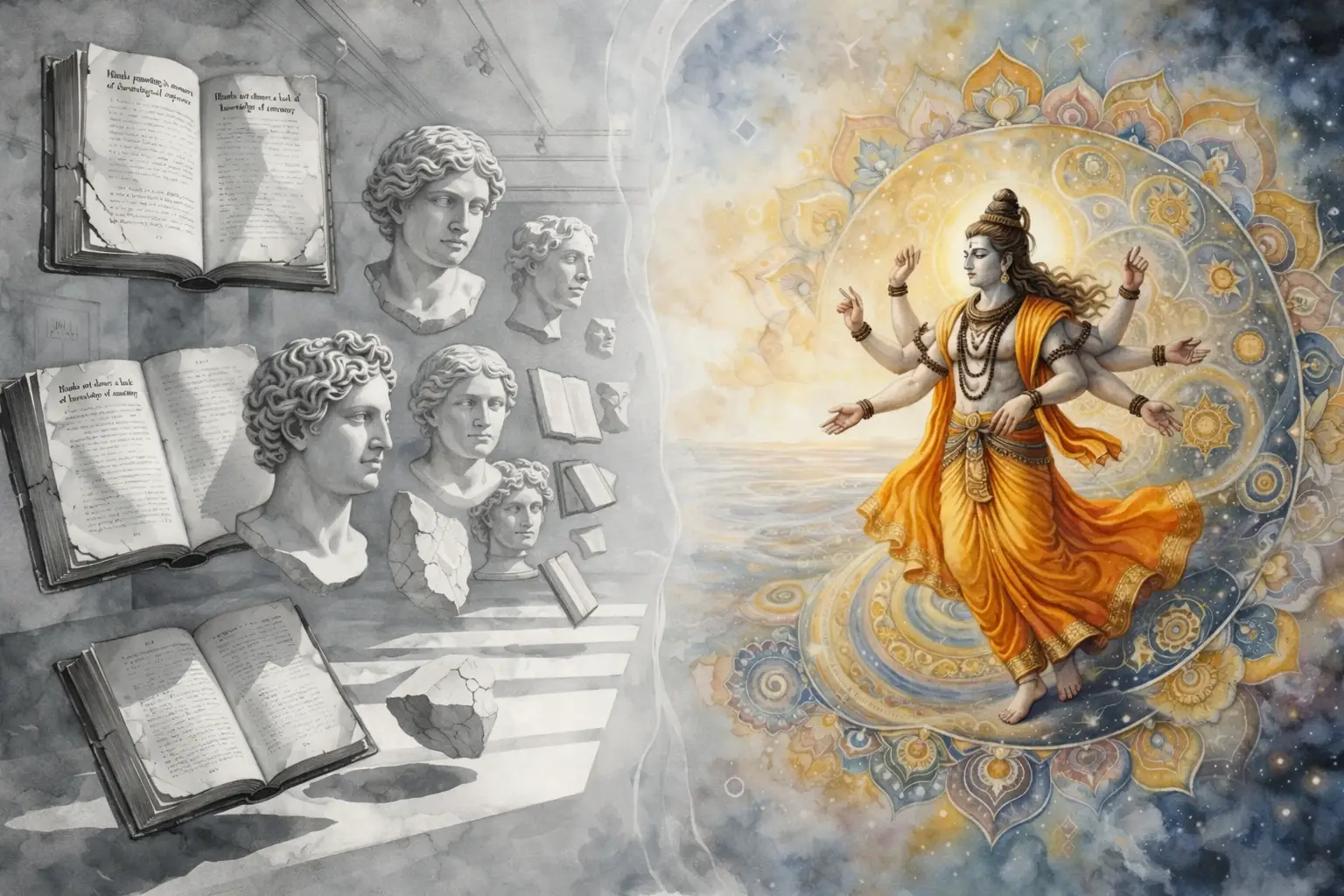
Hindu Aesthetics and Purva Paksha of Western Art

A research project applying Hindu aesthetic frameworks to Western art criticism, theory, and assumptions.

We have often read value judgements of Indian art in books written by western artists or art critics like: “Hindu painting is unaware of chronological sequence”; and that “Hindu art shows a lack of knowledge of anatomy”. These generalized statements which castigate entire civilization’s art with one sentence are not just stray comments but are part of textbooks that are taught not just in the West, but also in India. Because it is the West, which has so far in modern times, looked upon other cultures and their art and written about them, creating a narrative which shows more the Western mindset than the reality that they claim to cogitate upon.

The present study at Bodha aims to change this paradigm by reversing the gaze. It will look upon the Western art, its evolution and its theories from a Hindu aesthetic perspective. It will construct an aesthetic worldview where the Hindu paradigm is the dominant one and which overlooks and adjusts other traditions within that paradigm, while not letting their strengths or their contributions go unnoticed.

Also See

blog

Art and Meaning Making

Hindu aesthetics begins where Western aesthetics ends - the Indian tradition was interested in the effect of art on the soul, beyond the representation of reality, and this difference reveals two fundamentally incompatible metaphysical starting points.

external-article

Ancient Temples and Modern Dacoits Part III - The Architectural Workshop of the Gurjara-Pratiharas

The Gurjara-Pratihara dynasty as the defining force in north Indian temple architecture — the temple clusters of Morena and Naresar as laboratories where the distinctive regional style was forged.

external-article

Dharmic Circuits - The Temple, The Grove and The Lake - Part 3

Sringeri as the model of a complete sacred ecology — where the temple, the forest, the river, and the Vedic institution are not separate entities but one inseparable living system.

external-article

How Old is the Hindu Temple?

The antiquity of the Hindu temple examined through textual, sculptural, and archaeological evidence — dismantling the Western academic claim that temple architecture was a Buddhist invention absorbed by Hinduism.

external-article

Why Liberals Hate Baahubali

Why India's left-liberal cultural establishment hated Baahubali — the film as a mass rejection of the self-hating colonial aesthetic and a reassertion of Hindu heroism, beauty, and civilizational confidence that the establishment had worked decades to suppress.

book

Paratrishika Vivarana by Abhinavagupta

Abhinavagupta’s esoteric Shaiva commentary on language, mantra, consciousness, and manifestation.

book

Art Experience

Reflection on art, meaning, symbolism, and the experience of beauty in Indian thought.

book

Hindustani Music

Overview of Hindustani music theory, form, pedagogy, and performance practice.

book

Indian Concept of Performance

Study of performance as a conceptual and embodied category in Indian aesthetic theory.

book

On Natyashastra

Introductory or interpretive study of the Natyashastra and its framework for drama, performance, and rasa.

Loading search…