

Hindu Models of Temple Management

Research on traditional Hindu temple governance and indigenous models of temple administration.

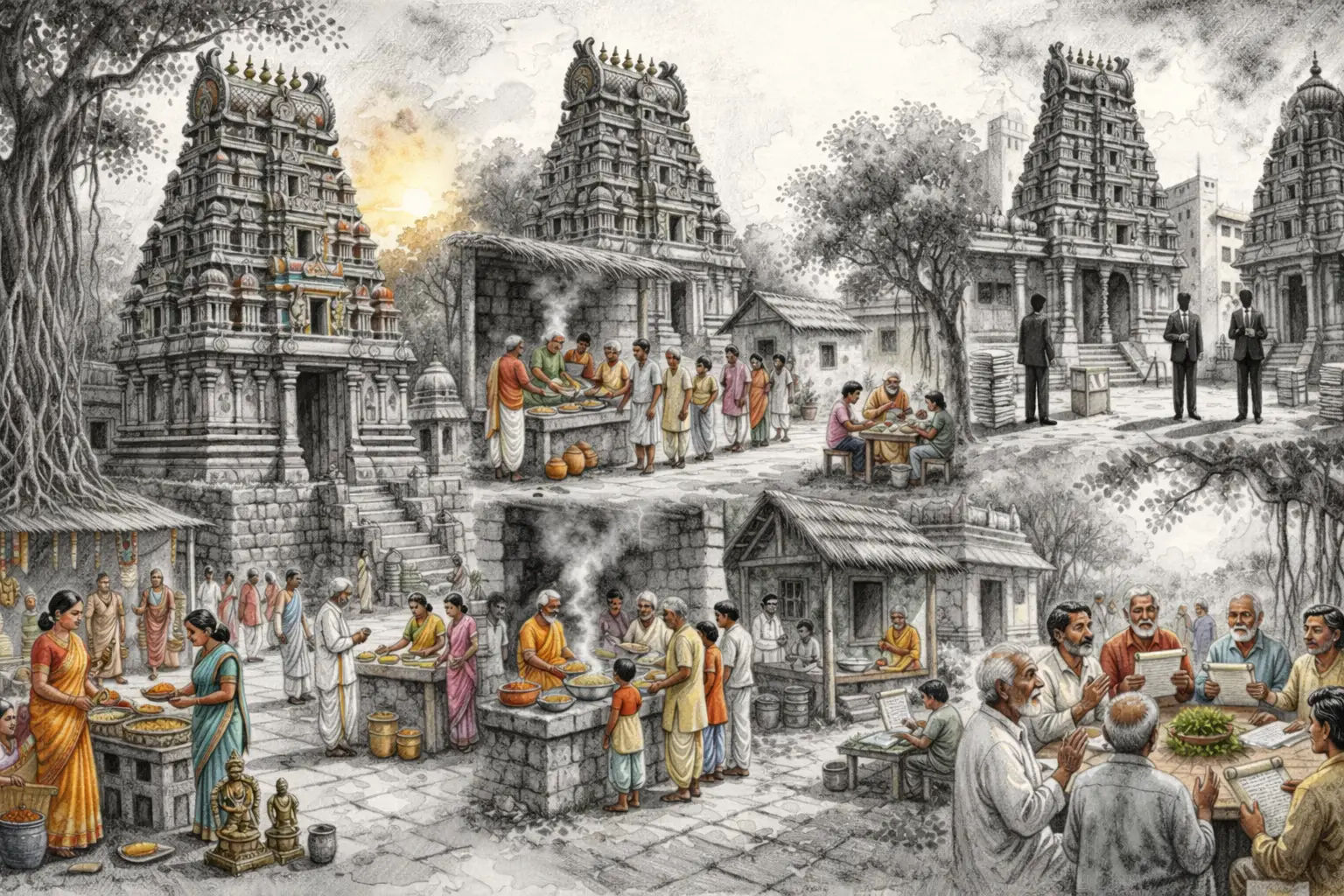
Our temples have been the center of our civilization for millennia, serving as the heartbeats of our cultural and spiritual identity. These sacred spaces stand as living examples of indigenous management and administration, meticulously crafted over centuries by devoted communities. Beyond their architectural grandeur, Hindu temples embody the essence of our collective ethos, playing multifaceted roles in our society. They serve as spiritual, religious, cultural, socio-economic, social welfare and paralegal institutions.

Yet, amidst their profound significance, the vital contributions of Hindu temples to our socio-economic fabric often go unnoticed. These sacred institutions have long served as engines of economic activity, generating employment, supporting local artisans, and stimulating trade in surrounding areas. They have also been bastions of social welfare, providing food, shelter, education, and healthcare to those in need. However, the integrity and autonomy of Hindu temples are increasingly under threat due to top-down management policies imposed by external authorities.

These policies, often devoid of cultural sensitivity and local context, undermine the intrinsic values and functioning of these sacred spaces. They impose bureaucratic hurdles, limit community participation, and erode the very essence of self-governance that has sustained our temple traditions for centuries. In response to these challenges, it is important to build cases that illuminate the efficacy of our traditional temple management systems. By studying the indigenous methods of administration and governance within temple ecosystems, we can showcase their holistic approach to societal well-being. This includes spiritual and religious functions as well as comprehensive social welfare initiatives.

Through rigorous research, documentation, and raising awareness, we can highlight the integral role of Hindu temples as pillars of community cohesion, cultural preservation, and socio-economic empowerment. By amplifying the voices of concerned Hindus and engaging in constructive dialogue with policymakers, we can pave the way for alternative models of temple governance that is conducive to our culture.

Also See

blog

The Goddess Who Summoned a Spring

A tale from a sthala purana of a time when a Goddess expressed her desire to dwell in a spot.

blog

Kannur - Discovering the Sacred Heart of Kerala through Bodha Anveshi

A deeply personal and evocative travel narrative through Kerala, capturing the transformative beauty of India’s lush southern landscapes. Blending wanderlust, heritage, and introspection, with authentic insights into Kerala’s timeless traditions, temple culture, and scenic charm.

blog

My Journey with Anveshi

The origin story of Anveshi, Bodha's structured temple-visit practice - how collective temple-going became a form of civilizational reconnection - and what it reveals about how living tradition actually perpetuates itself.

blog

Ram Ayenge | Ayodhya Rama Temple Devotion and Hindu Awakening

A first-person account of the devotional groundswell preceding the 2024 Ayodhyā pratiṣṭhā - what a spontaneous civilizational awakening looks and feels like from the inside - and what it reveals about the living roots of Hindu consciousness.

blog

Śrī Rāma Comes Back to Ayodhyā

The Ram Janmabhūmi movement as civilizational memory rather than political campaign - how the 500-year struggle for Ayodhyā maps onto the deeper Hindu understanding of sacred geography and the permanence of divine presence in place.

blog

Kṣetra, Śāstra, Utsava

On the axis connecting festival (utsava), sacred geography (kṣetra), and scripture (śāstra) - how Hindu festivals are to time what temples are to space - gradients of divine access that structure both the year and the land.

external-article

Ancient Temples and Modern Dacoits Part III - The Architectural Workshop of the Gurjara-Pratiharas

The Gurjara-Pratihara dynasty as the defining force in north Indian temple architecture — the temple clusters of Morena and Naresar as laboratories where the distinctive regional style was forged.

external-article

Dharmic Circuits - Sacred Pathways - Part 1

The Hindu geography of Bharatvarsha as a structured sacred space — how teertha yatra creates a living network of centers and pathways that defines the cultural boundaries of the civilization.

external-article

Dharmic Circuits - The Temple, The Grove and The Lake - Part 3

Sringeri as the model of a complete sacred ecology — where the temple, the forest, the river, and the Vedic institution are not separate entities but one inseparable living system.

external-article

How Old is the Hindu Temple?

The antiquity of the Hindu temple examined through textual, sculptural, and archaeological evidence — dismantling the Western academic claim that temple architecture was a Buddhist invention absorbed by Hinduism.

external-article

The Many Meanings of the Hindu Temple

The Hindu temple as simultaneously sacred mountain, cosmic axis, human body, and gateway between worlds — a layered symbolic reading of the temple form as encoded theological knowledge made visible in stone.

external-article

On What is a Hindu Temple

Dr. R. Nagaswamy on the essential nature of the Hindu temple — what it actually is, why its origins predate Buddhism, and how the Western academic genealogy that credits Buddhism with inventing the temple form gets the history exactly backward.

external-article

Story of a Priest

Portrait of the head priest of the Hoysala-era Veera Narayana Temple at Belavadi — how a 12th-century heritage temple survives and what the priest's life reveals about the community of practice that keeps the living tradition alive.

book

A Timeline Of Ayodhya

Historical and archaeological timeline of Ayodhya, tracing settlement layers, textual references, and cultural continuity from ancient to medieval periods.

Loading search…